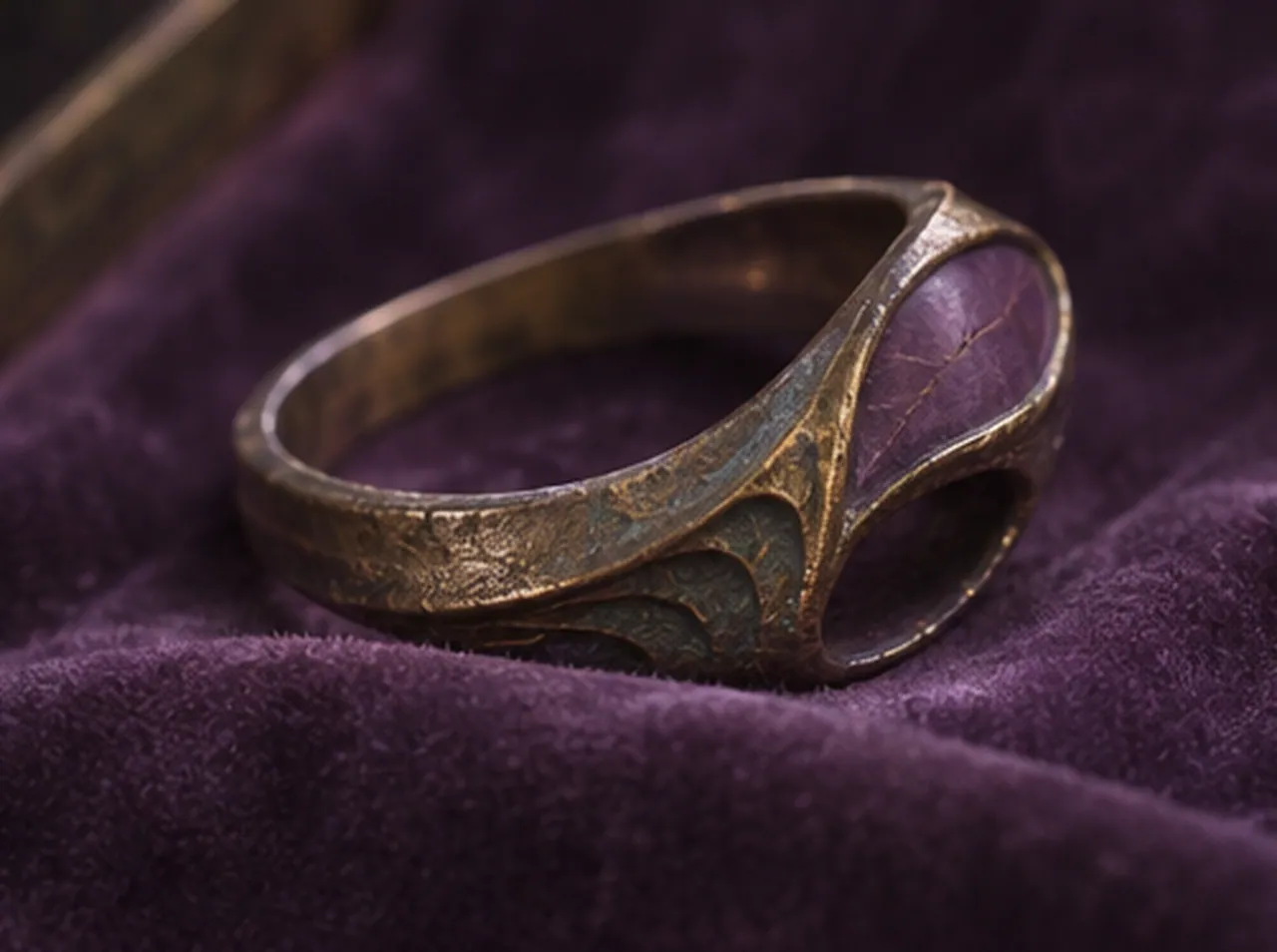
Mark on the Guardian Ring
The keeper’s ring fits the old stockroom lock but its surface also holds a line that seems to point to a former storage bay. There are three worn points along its rim. One follows the direction of a slot. One looks like a scratch that another keeper could have made. The third is an earlier repair. Mark on the Guardian Ring is a concept for following a route through weakly marked places with that ring as a portable reference.
Get one reliable face of the object
Before trying any locks, the player keeps a drawing of the ring from the side where the gap in its oval is easiest to see. A wall slot shares a small alignment with that gap. Setting the ring beside it lets the player inspect the angle without forcing the ring into a convincing position. One can still rotate the object, compare the false fit, and turn it back. The drawing supplies a fixed orientation when the next shelf face is harder to inspect. It can remain on the screen beside a chip in the porcelain, so a detail apparent only under raking light still has a useful position.
Follow wear without mistaking it for a label
The middle stretch of the route includes several similar shelf brackets. Each has the diagonal groove that comes from the usual way of taking something down. The ring’s outside gouge bends at the top where a repair has become part of the surface. The player looks for a bend and a particular slope together. The Unnumbered Storage Walk deals with a corridor whose shelf numbers vanished and which must instead be read from the turn at the end. A Scratch That Appears Twice follows the problem of a matching mark that may have arisen from the same routine action.
Keep a route that can survive an error
When the player chooses a likely bay the room does not close off its other side. A nearby worktop can hold their likely route while they take the ring to another angle. If the selected bay and a drawing no longer agree, they can move one hook along the line without removing the earlier observation. The object still came through somebody’s hands. A wrong bay should leave behind one useful reason why the match looked convincing, such as a universal groove at the edge of any kept object. The next bay offers a different test of the unusually shaped bend.
Long shadows on shallow surfaces
The ring is purple-black below, with a polished lip where the hand most often turns it. There are olive highlights on old screws and pale strips of porcelain underneath each shelf. The overall space stays cool enough for warmth to indicate reflected light within a recess. Scratches cast shadows that show their width and direction. They are part of the ring as an object before they become puzzle evidence. Close details should remain readable without a color cue.
Give the seeker a route of their own
The current concept can be explored with a rough ring model and two shelves that suggest different explanations for the same shape. A small test can ask someone to locate an uncertain link without resolving every part of the history. A useful outcome is a player able to point to the corner where they would check again. That makes the search longer in the way an adventure needs, with places to reconsider and better questions for each return.